|
|||
| HONG KONG | <Search <Archives <eBulletin | ||

April 7, 2026 Kai Tak Smart & Green Mass Transit System officially approved Project Cost, Approval Milestones, and Implementation Timeline (2017–2031) -- At the end of March 2026, the Hong Kong government reached a pivotal milestone in advancing the Kai Tak Smart and Green Mass Transit System (SGMTS). On 31 March 2026, the Executive Council (ExCo) formally authorized the railway scheme under the Railways Ordinance. This approval represents a critical transition for the project, elevating it from a stage of planning and consultation into one of official implementation readiness. The authorization signifies that the government has completed all required statutory procedures, including the review of public feedback and objections gathered during earlier consultation phases. By granting approval, ExCo confirmed the final alignment, station locations, and overall design of the system. This step also reflects a level of public and institutional consensus, indicating that the project has gained sufficient support to proceed despite earlier debates over cost, design, and feasibility.
Importantly, this approval does not mark the start of construction but rather clears one of the final legal and administrative hurdles. The project is already in an active tendering phase, with the government seeking a private partner under a build–operate–transfer model. With the statutory authorization now in place, the next steps involve evaluating bids, awardin
 g the contract—expected within 2026—and preparing for construction to begin shortly thereafter. g the contract—expected within 2026—and preparing for construction to begin shortly thereafter.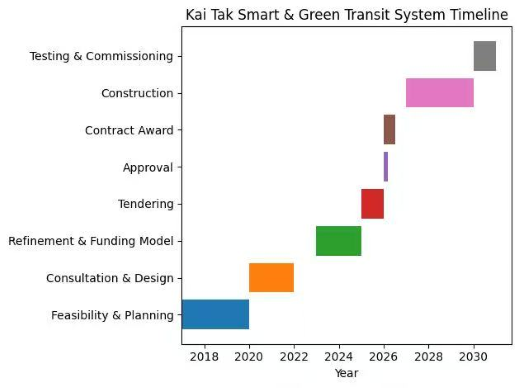 The significance of this development lies in its role as a formal “green light” for the project. It demonstrates the government’s commitment to delivering a modern, environmentally friendly transit system to support the growing Kai Tak development area. While uncertainties remain—particularly regarding costs, contractor interest, and timeline risks—the March 2026 approval firmly positions the project on a path toward realization, with a target completion date around 2031.
Project cost (latest estimate)
The most recent government estimate places the cost at approximately:
• HK$12–15 billion (about US$1.5–1.9 billion)
However, under the Build–Operate–Transfer (BOT) model:
• A private consortium will finance and build the system
• The government reduces direct upfront spending by granting property development rights along the corridor
(Reported by Building.hk)
 (HKSARG)
 |
|



|