|
|||
| HONG KONG | <Search <Archives <eBulletin Next> | ||

February 7, 2026 Hong Kong's Dual-Innovation Transport Blueprint: Shaping the Next Two Decades of Urban Development The Hong Kong SAR Government has released a new transport strategy blueprint founded on a dual-innovation approach that integrates policy innovation and technological innovation, setting out a forward-looking vision for the next two decades. Structured around three overarching themes and six strategic frameworks, the blueprint puts forward 25 specific recommendations, of which 10 are priority measures to be implemented within the current year. The approach reflects a deliberate balance between long-term strategic planning and responsiveness to citizens’ everyday mobility needs.
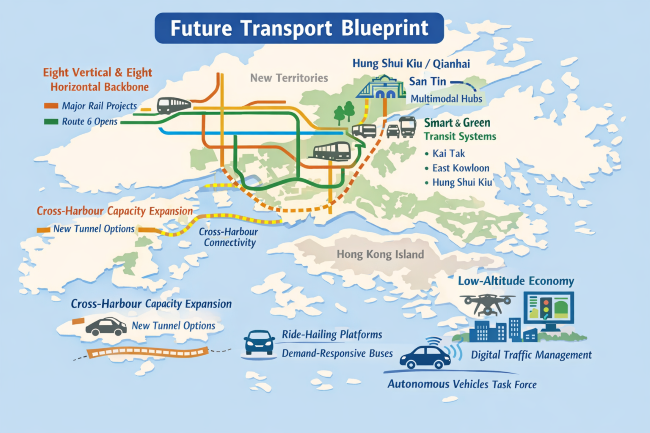
At the infrastructure level, the blueprint reinforces the “Eight Vertical and Eight Horizontal” strategic transport framework. Key short-term actions include the full commissioning of Route 6 within the year and the accelerated delivery of a series of railway and major road projects. This infrastructure-led strategy, which positions transport corridors as the backbone supporting new development areas, will have significant implications for land supply, spatial structure, and urban density distribution.
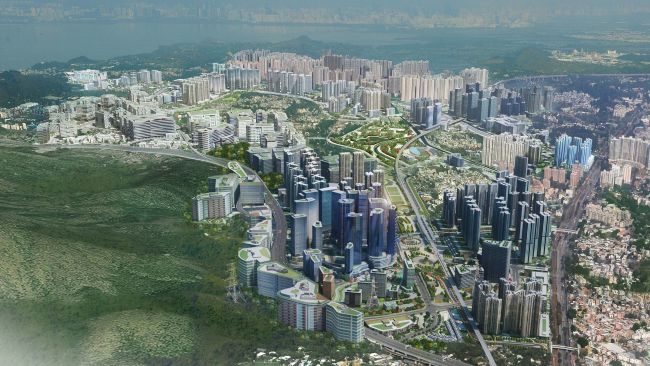
Of particular relevance to architectural and planning professionals is the planned study of the southern extension of the Hong Kong–Shenzhen Western Rail Link (Hung Shui Kiu to Qianhai), alongside the development of multi-modal, next-generation transport interchanges at strategic nodes such as Hung Shui Kiu, San Tin, and Hung Hom. These initiatives signal an increasing role for transport infrastructure as a catalyst for integrated, high-intensity, and vertically layered urban development.
 (HKSARG)
Regarding cross-harbour connectivity, the Government will explore various options to expand cross-harbour traffic capacity, including new alignments or the expansion of existing tunnels. This reflects an ongoing need to overcome structural mobility constraints between the two sides of Victoria Harbour. Any future solution will inevitably affect land use planning, underground space utilisation, and large-scale engineering integration along the harbourfront.
In both new development areas and urban regeneration zones, smart and green mass transit systems will be introduced in Kai Tak, East Kowloon, and the Hung Shui Kiu/Ha Tsuen New Development Area. These systems should be understood not merely as transport projects, but as instruments reshaping street hierarchy, public realm design, and neighbourhood accessibility. Early integration of transport planning with architectural and urban design considerations will therefore be critical.
Public transport and personalised mobility services are also undergoing transformation. Demand-responsive smart bus pilot routes will be launched, alongside the introduction of licensed ride-hailing platforms and an increase in parking provision for private and commercial vehicles. Together, these measures point to a more flexible, data-driven mobility ecosystem, raising new considerations for parking standards, podium and basement design, and traffic impact assessment methodologies.
Technology adoption forms a central pillar of the blueprint. The Government will advance digital traffic management through big data and artificial intelligence, including the establishment of the first urban traffic management platform pilot. At the same time, a cross-departmental task force will be formed to promote the application of autonomous vehicles and to develop a roadmap for autonomous passenger services. These developments suggest forthcoming structural changes in road design, pick-up and drop-off configurations, and regulatory frameworks. In parallel, the formulation of the Low-Altitude Economy Development Action Plan introduces new dimensions to three-dimensional city planning, including building height control, rooftop utilisation, and airspace governance.
 (Building.hk)
From a people-centric street management perspective, the blueprint proposes the expansion of AI-enabled real-time traffic signal control and the wider implementation of diagonal pedestrian crossings. These measures underscore a stronger emphasis on pedestrian efficiency and safety, with direct implications for street interface design and the enhancement of public space quality.
Overall, this transport strategy blueprint should be viewed not only as a policy document on mobility, but as a strategic framework shaping Hong Kong’s future urban form, infrastructure investment, and technology integration. (Reported by Building.hk)
 |
|



|